
Flocking technology
Why a flocked tip releases more of the specimen than a wound fibre swab — and what that means for assay sensitivity.
Millions of fibres, standing straight up
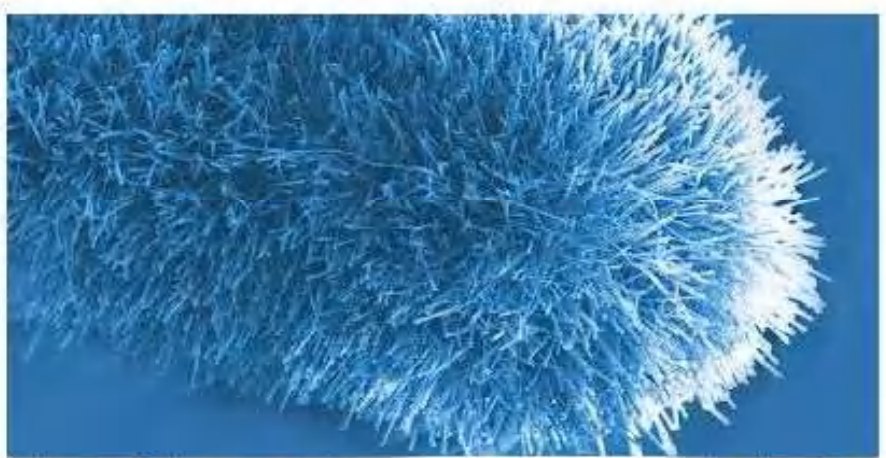
In electrostatic flocking, the medical-grade handle tip is passed through a charged field while nylon micro-fibres are sprayed onto it. The charge drives each fibre into the adhesive-free surface perpendicular to the tip, so the head ends up looking like a soft brush rather than a wound sponge.
Because the fibres stand up, the specimen stays in the gaps between them instead of being pulled into a dense fibre mattress. Capillary action between the strands gives strong hydraulic uptake, and the sample comes back out almost as fast as it went in.
- Fibres attached perpendicular to the handle tip
- Completely inert components — no adhesive residue, no fibre treatment
- Consistent fibre density from swab to swab
- Certified RNase free and DNase free for PCR workflows
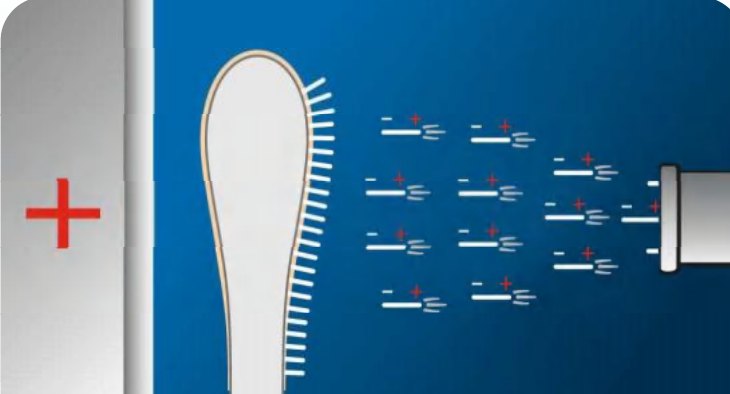
Charged nylon fibres are sprayed onto the handle tip and stand perpendicular to the surface.
95% versus 25%
Published comparisons of flocked and standard fibre-tipped swabs show the flocked tip releasing up to 95% of the collected sample, against roughly 25% for a wound fibre swab. When the sample volume is small, that difference decides whether the assay has enough material to work with.

Traditional fibre swab
Sample diffuses into the fibre mattress and stays trapped; only part of it reaches the transport medium.
Nylon flocked swab
Sample sits at the surface of the perpendicular fibres and elutes rapidly and spontaneously.
Built around the collection workflow
Moulded breakpoint
Snap the handle at the moulded line and drop the tip straight into the tube. Breakpoints from 22 mm to 95 mm, with dual 30 / 80 mm options for multipurpose kits.
Frosted tail
A frosted grip zone helps the donor hold the swab during self-collection and gives the lab a clear handling area.
Ejective tip
On CY-98000PS and CY-98000FS the tip is ejected into the tube by pressing the swab end with the thumb — no handling of the tip.
Colour-coded handles
Green, blue and red handles on CY-98000DM and CY-98000RC for site or protocol segregation.
Patented ball tip
CY-96001 uses a rounded ball end that is gentler on narrow anatomy than a cut tip.
Stopper ring
CY-96000-54 adds a stopper at 30 mm to control insertion depth.
Where these swabs are used
The catalogue spans every common specimen type — the table on the products page lists the recommended application for each transport tube configuration.
- Molecular diagnostics and PCR sample collection
- Rapid antigen and rapid diagnostic testing
- Cytology and clinical microbiology
- Nasopharyngeal, oropharyngeal, nasal, oral and cervical sampling
- Forensic evidence collection
- Food safety and environmental surface testing
Need samples or a formal quotation?
Tell us the application, tip size and breakpoint you need. We reply to every enquiry within one business day with specs, packing data and lead time.